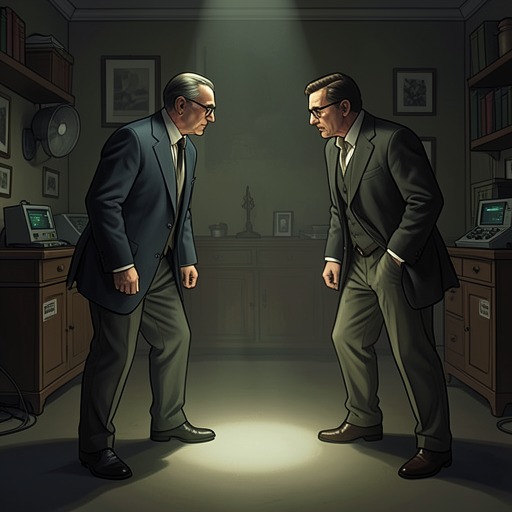
Keyhole scene
Being and NothingnessThe keyhole episode is a philosophical scene in which a furtive act becomes a demonstration of how the Other’s look changes the person who is seen. At first, the spy is absorbed in a practical arrangement of door, keyhole, and desired spectacle, acting without taking themself as an object of judgment. A footstep abruptly alters that relation: shame discloses a self whose meaning escapes its own control and exists for another. Even a false alarm does not undo the discovery, because the Other’s presence as a subject is distinct from the uncertain fact of someone’s physical presence in the corridor.
The act organized by its end
The scene begins with a person alone, moved by jealousy, curiosity, or vice, pressing an ear to a door and looking through its keyhole. The action is not initially presented as an object for self-judgment. The consciousness is absorbed in what is to be seen and heard: the spectacle beyond the door, the conversation, and the practical demands of getting close enough to perceive them. The spy does not first observe themself as a person performing a morally describable act; they are engaged in the act itself.
The door and keyhole appear at once as instruments and obstacles, with practical demands attached to them: handle them carefully, look through the opening from nearby and slightly to one side. The scene’s details form an instrumental arrangement rather than a collection of neutral objects. The keyhole matters because of the spectacle sought through it, and the means acquire their significance from that end. The end organizes the preceding actions, so the means do not stand apart as independently meaningful things.
Jealousy gives this arrangement its direction, but the spy does not know jealousy by pausing to inspect it. The jealousy is lived as the free project that makes a spectacle behind the door matter; at the same time, the arrangement of the world can disclose the jealousy as an objective fact. The scene thus describes a situation in which the surrounding objects and tasks reflect both facticity and freedom: a particular world presents possibilities to be freely taken up, without simply compelling the action.
Before the interruption, there is no external perspective that turns the spy’s conduct into a settled object for judgment. The person is their acts, and those acts are oriented toward the end and the instruments that serve it. This absorption also carries the possibility of evasion: the spy cannot fully fix themself as the person listening at doors, because their freedom exceeds any provisional description of what they are doing. The episode links that flight from a fixed self to the emergence of bad faith.
The footstep and the arrival of shame
The turning point is sudden and acoustic. The spy hears footsteps in the hall and realizes that someone may be looking. This interruption changes the structure of the experience: the person is no longer absorbed only in the spectacle and the means of spying, but is affected in their being by the possibility of becoming an object for another. The change is apprehended through reflection, yet the first disclosure is lived rather than acquired as detached knowledge.
The self that appears in this moment is not simply an object the spy has chosen to inspect. It haunts unreflective consciousness because the person now experiences themself as existing for the Other. The self is not directly possessed as an object for oneself; it is encountered as a self another can know and judge. Shame, and in other circumstances pride, reveals both the Other’s look and the self at the end of that look.
Shame makes the structure especially plain. It is shame of oneself: recognition that one is indeed the object the Other sees and judges. The spy’s freedom escapes into an existence given from outside, so the bond between unreflective consciousness and the self being looked at is a bond of being, not merely of knowledge. The person lives the situation of being seen rather than first forming a detached account of it.
That change reaches beyond the person to the setting. The walls, door, and keyhole, once organized as instruments in the spy’s project, now turn toward the Other and acquire a face that escapes the spy’s control. The world seems to flow toward the Other, while the spy experiences themself as displaced beyond their own command of their being. The same material arrangement therefore carries two different orientations: first a practical route to a desired spectacle, then a world in which the spy’s exposure is visible to another.
The false alarm does not erase the Other
The episode tests its discovery through a mistaken perception. Bent over the keyhole, the spy hears a footstep, shudders under a wave of shame, straightens, and scans an empty corridor. The apparent observer is not there; relief follows. Yet the mistake does not show that being an object for the Other was itself an error. What fails is the belief that the Other is concretely present in that particular place at that particular moment.
If the spy continues the attempt, the Other remains consequential without appearing in the corridor. The person’s heart beats fast, the slightest noise or stair creak becomes significant, and nearby rooms, the space above and below, and a dark corner become places where someone could be. The possibilities that unfold through the stairway and the hidden corner sustain the experience of being-for-others. The spy’s possibilities continue to die under the imagined look, and shame may remain visible in a red face bent over the keyhole.
The distinction is between the Other as subject and the contingent fact of the Other being there. The look is not secured only by identifying a pair of eyes in the world; converging eyes or other perceived signs can be occasions for realizing that one is looked at. The false alarm withdraws a particular worldly presence, not the Other’s subjectivity or the altered sense of exposure. The episode therefore makes the observer’s location uncertain while preserving the force of being seen.
The scene’s reversal
The episode is structured by reversal. At first, the spy’s attention runs outward through a narrow opening, and every object is organized by the spectacle to be reached. Once the look is apprehended, the spy cannot hold that world in the same way: attention to being looked at makes perception of the world recede into the background. The person who had treated the keyhole as a route for seeing becomes conscious of themself as seen.
The empty corridor supplies no final escape from that reversal. Its emptiness corrects a claim about where the Other is, but it cannot return the spy to the earlier innocence of absorbed action. Shame has disclosed a self that the person is without knowing, a self whose being is exposed to another’s judgment. In this sense, the keyhole is more than the instrument of spying: it marks the threshold at which a private project becomes a situation of exposure, and at which the world’s arrangement for the spy can turn toward the Other.